Sponsored article
How Do Seams, Lining and Finishing Determine Whether a Stole Keeps Its Shape During a Celebration?
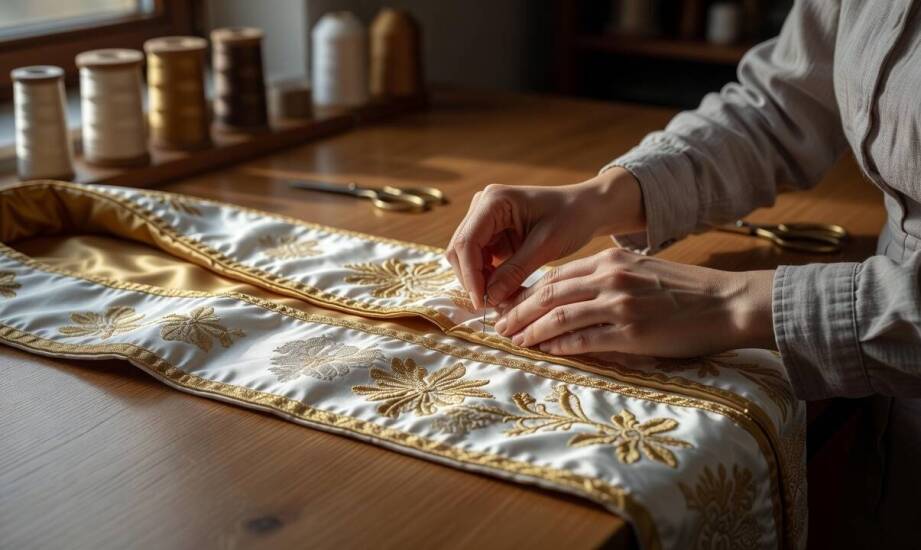
A liturgical stole is one of the most important symbols of ordination and priestly ministry. It is also a vestment that should maintain a perfectly symmetrical appearance throughout the celebration. During the liturgy, a priest performs numerous gestures, while the chasuble worn over the stole constantly places pressure on the fabric.
The construction of the stole determines whether it remains flat and aesthetically balanced throughout the Mass. A poorly designed model may twist on the shoulders, wrinkle across the chest, or hang unevenly. For this reason, proper tailoring requires a careful choice of construction techniques and materials.
Dimensions and the Symmetry of the Fabric
The length and width of a stole depend largely on the priest's height, personal preferences, and the specific design used by the tailor.
Historical and industry sources show that there is no single universal standard defining these dimensions for the entire Church. In practice, many stoles feature individual panels measuring approximately 120–135 cm in length and 13–16 cm in width. These figures should be treated only as examples rather than fixed requirements.
Well-balanced proportions help the ends of the stole hang evenly and parallel across the chest, taking into account the body shape of the wearer.
A stole that is too short may rise above the edge of the chasuble when the priest raises his arms. One that is too long may fold or gather around the knees, restricting movement at the altar.
Width also directly affects stability. Wider variants can improve balance and distribute weight more evenly across the shoulders.
Balancing the Weight of Embroidery and the Base Fabric
Rich machine embroidery significantly influences the overall weight of a finished stole.
Patterns concentrated heavily at the lower ends add weight that may cause twisting if not distributed evenly. The base fabric must compensate for this localised load. High-quality jacquard fabrics and specialised wool-polyester blends with a higher fabric weight are often used for this purpose.
When embroidery is concentrated on only one side, the heavier section naturally begins to pull downward. As a result, the stole loses vertical symmetry and requires repeated adjustment during the liturgy.
To prevent this, craftsmen creating liturgical vestments often use symmetrical Eucharistic motifs, floral ornaments, or crosses. Even decoration placement helps maintain balanced weight on both sides of the stole.
The selection of woven decorative bands is equally important, as they should not be excessively rigid compared with the softer base fabric.
The Role of Lining and Internal Reinforcement
The inner layers of a stole play an important role in both comfort and durability.
A smooth lining made from satin or tightly woven cotton reduces movement between the internal fabric layers. This helps the stole maintain a flat appearance along the body, even during lengthy liturgical celebrations.
However, careful lining alone is not enough. Between the outer fabric and the lining, tailors typically place a reinforcing layer.
Traditional liturgical tailoring often uses sturdy cotton canvas or professional interfacing materials. This technique gives the entire stole a stable structure, preventing the fabric from collapsing into the natural contours between the shoulders.
Hidden edge seams must be executed with exceptional precision. Many craftsmen use turning techniques that allow seam allowances to be enclosed inside the garment. Poorly sewn seams can create visible ripples that become noticeable beneath lightweight albs.
How Different Vestments Affect the Construction
The same stole behaves differently depending on the garment worn over it.
A Gothic chasuble is characterised by a wide cut and generous drape. Under this style, the stole experiences less friction and its weight is naturally supported beneath the outer folds.
A Roman chasuble or a heavily decorated cope presents a different challenge. In these cases, the lower ends remain fully visible and must maintain a smooth, flat appearance despite lateral pressure from other vestments.
Edge finishing becomes especially important. Fringes can add elegant movement, but they require strong reinforcement to withstand years of use and cleaning.
Mitred corners, carefully folded and angled at the edges, help prevent fraying and significantly extend the lifespan of the garment.
During outdoor processions, particularly when wearing a cope, the fabric is subjected to greater movement around the neck and shoulders. Models featuring internal reinforcing trim generally perform better under these conditions.
Models Designed for Parish and Missionary Use
Daily parish ministry and missionary work place high demands on liturgical vestments.
Models made from densely woven jacquard fabrics generally provide good resistance to creasing, making them easier to transport during travel.
Modern machine embroidery helps decorative elements maintain their appearance despite regular use and cleaning.
In challenging missionary environments, where high temperatures and humidity are common, lighter constructions often perform better. Breathable cotton linings combined with lighter internal reinforcement can improve comfort during extended celebrations.
Maintaining proportional width and a perfectly symmetrical arrangement of decorative elements also reduces the risk of the stole slipping from the shoulders during baptisms, anointing ceremonies and other sacraments.
Combining Symbolism with Craftsmanship
A carefully crafted liturgical vestment combines deep theological meaning with precise attention to physical balance and structure.
Every hidden construction detail influences whether the garment remains dignified, comfortable and stable throughout the liturgy. Creating such vestments requires a thorough understanding of movement, fabric behaviour and textile characteristics.
At Ars Sacra, traditional tailoring principles are combined with the practical requirements of modern clergy. The use of suitable breathable linings, carefully balanced embroidery and precisely finished hidden seams helps ensure that vestments retain their elegant appearance and remain suitable for many years of ministry.
Key Takeaways
A stole should maintain a symmetrical appearance during movement despite pressure from a chasuble and frequent liturgical gestures.
Length and width influence the way the ends hang, shoulder stability, and freedom of movement.
The weight distribution of embroidery affects whether the stole twists or remains properly aligned.
Lining, reinforcement and precisely sewn edges help maintain a flat appearance throughout the celebration.
Edge finishing influences both aesthetics and long-term durability.
The same stole may behave differently under a chasuble, a cope, or during a procession, making construction details especially important.
FAQ
Why can a stole twist during a celebration?
A stole most commonly twists because of uneven embroidery weight distribution, insufficient internal stabilisation, or inaccurately sewn edges. When one side becomes noticeably heavier, the stole may hang unevenly and twist during movement. Symmetrical embroidery, appropriate lining and suitable reinforcement help minimise this issue.
Which construction features are most important for a frequently used stole?
Densely woven base fabric, stable lining and durable finishing generally provide the best results. Balanced proportions and symmetrical decoration layouts also help prevent deformation during everyday liturgical use. In practice, durability and appearance must work together.
Should a stole worn under a chasuble and under a cope be made in the same way?
Not necessarily. Different outer vestments influence the way the fabric behaves. Under a wider chasuble, the stole typically has more freedom of movement, whereas under a cope or Roman chasuble it may require greater stability at the ends. The construction should therefore reflect the intended use and level of mechanical stress.
You might be interested

Differentiation of the wholesale mushroom offering as support for culinary creativity
How to Choose the Right Diameter for a Ceramic Breakfast Plate
What to look for when choosing a store offering polish vestments?